Why Humans Are Wired to Tell Stories About the Stars

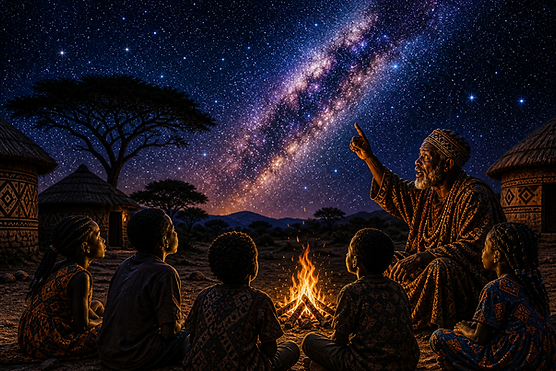
Long before telescopes, before science had names for galaxies and gravity, humans were already looking up—and telling stories.
Not just any stories.
Stories about gods, spirits, ancestors… and worlds beyond our own.
Across continents and cultures, from West African sky legends to ancient Greek constellations, something remarkable appears again and again:we don’t just see stars—we turn them into meaning.
So why do we do it?
🌌 The Brain That Seeks Patterns
The human brain is wired to find patterns—even where none exist. It’s the same instinct that once helped us survive: spotting movement in the bushes, recognising faces in the dark.
But when we look at the night sky, that instinct does something extraordinary.
It connects the dots—literally.
Random points of light become hunters, animals, heroes, and warnings. The sky becomes a storybook.
And once a story exists, it becomes memorable.
🔥 Stories Were Our First Science
Before equations, there were narratives.
Early humans used stories to explain what they couldn’t yet measure:
Why the seasons change
Why certain stars appear at certain times
Why the night can feel both beautiful… and terrifying
In many African traditions, the stars weren’t just distant lights—they were guides, calendars, and teachers.
Stories helped communities pass down survival knowledge across generations.
In other words:storytelling wasn’t entertainment—it was technology.
🧠 Why Stories Stick (Even Today)
Even now, in a world of satellites and space telescopes, stories still shape how we understand the universe.
Why?
Because stories activate emotion.
And emotion is what makes information stick.
You’re far more likely to remember:
a child navigating a distant planet
than
a list of planetary facts
This is exactly why science fiction works so powerfully—it turns cold space into human experience.
🚀 From Ancient Fires to Distant Planets
The stories may have changed—but the instinct hasn’t.
Where ancient storytellers once spoke of spirits in the sky, we now imagine:
alien worlds
interstellar travel
civilizations beyond our own
Different language. Same curiosity.
That same instinct lives in every child who looks up and wonders:“What’s out there?”
🌍 Why This Matters More Than Ever
In a world filled with noise, storytelling remains one of the most powerful tools we have.
It builds curiosity.It sparks imagination.It makes science feel alive.
And for young minds especially, stories about the stars don’t just explain the universe—
They invite them into it.
✨ Final Thought
Every civilisation has looked up at the same sky…and told a different story.
Maybe the stars were never just meant to be studied.
Maybe they were always meant to be told.
If you enjoy stories that blend science, imagination, and adventure, you’ll love the world of Attack on Planet Falrus—where curiosity isn’t just encouraged… it’s how worlds are saved.
And check out Storyplanet Youtube for more on stories about the stars.
All my love,
Joanna


Comments